 Curious MachinesCheck the proof ↓
The 41st
Sphere.
Six oranges fit around one on a table. In five dimensions, forty spheres fit around one. Can you make room for one more?
Try the 41st sphere →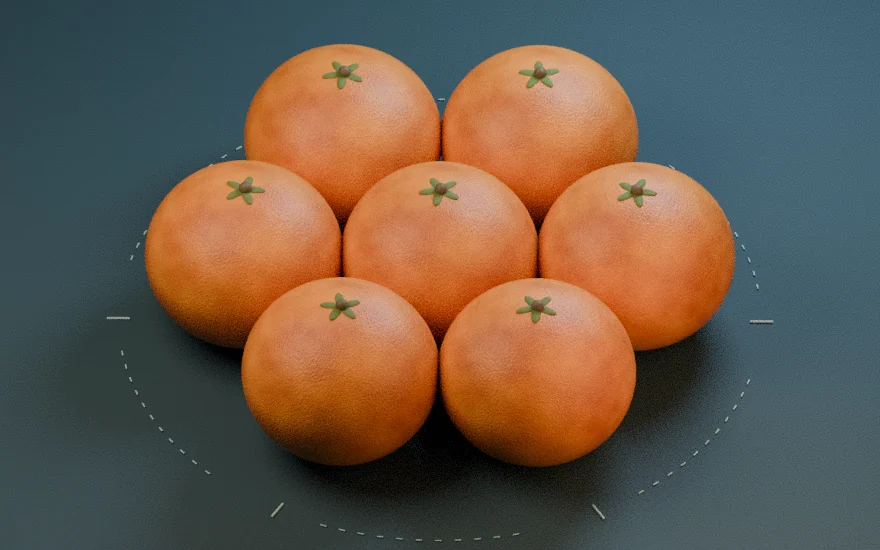
The packing table
All centers lie in one plane. Drag to rotate the view.
Which pair is colliding?
Inspect overlapping pairs
First, beat the table.
A 41-point arrangement only works if its worst pair clears 60°. Kevin Li’s configuration in Henry Cohn’s table is a stronger benchmark than our independent searches. Its optimality is unknown.
| Configuration | Minimum angle | Distance to 60° |
|---|---|---|
| Our first 54 starts | 58.958648° | 1.041352° |
| Our next 36 starts | 58.964728° | 1.035272° |
| New search · independent of Li | 58.965303° | 1.034697° |
| New search · started from Li | 59.022181° | 0.977819° |
| Kevin Li · published table | 59.022196° | 0.977804° |
| Required for 41 to fit | 60.000000° | 0° |
The first 90 starts reached 58.964728°. We ran 2,392 more, including 64 trials that searched directly for a configuration meeting 60°. Some trials reused earlier candidates. We removed points from larger published configurations, exchanged whole hemispheres between candidates, and let all 41 points move. Our best independent result still has 177 overlapping pairs. Points 8 and 17 come closest. Starting from Li’s coordinates brought us back to within 0.000016° of his score.
How much of the forty has to change?
Pin any 37 of the standard forty in place. Even if every other sphere can move freely in five dimensions, the total still cannot exceed 40. That rules out any attempt to fit sphere 41 by rearranging just one, two or three of the standard neighbors.
Why keeping 37 pins down the answer
A new direction that fits beside 37 fixed neighbors has two possibilities. It can occupy one of the three vacant positions. Or it clashes with all three vacant positions and falls inside a particular spherical cap. The cap is too narrow to hold four mutually separated points. The proof notes show the cap, the six pair angles used in the argument, and the two small systems of inequalities checked with exact fractions.
How 962 candidate directions can be ruled out together
Eight patterns of five integer coordinates generate 962 directions by flipping signs and exchanging axes. We grouped directions that overlap one another. Each group can contribute at most one sphere. Weighting those groups and counting how often each direction appears gives an upper bound of exactly 40. The bound still holds if every chosen direction moves up to 0.23°. For the 242 directions made from zeroes and ±1, the margin grows to 2.63°.
A valid arrangement could still use other directions. The certificate files contain the integer coordinates and the weights needed to check these two bounds.
Why simply adding one sphere cannot work
Keep the standard forty fixed. Their directions have two coordinates equal to ±1 and the other three equal to zero, before normalization. For any new unit direction, call its two largest absolute coordinates a and b. One of the forty matches their positions and signs. Its dot product with the new direction is (a + b)/√2.
Since the remaining three coordinates are at most b in magnitude, 1 ≤ a² + 4b² ≤ 5(a + b)²/4. The last inequality follows from (a − b)(a + 11b) ≥ 0. So the closest neighbor is at most arccos(√(2/5)) ≈ 50.76848° away. A direction with all five coordinates equal attains that angle. To reach 60°, some of the original forty must move.
What is known about the maximum?
The classical D₅ arrangement proves that forty fit. Cohn and Rajagopal discuss several distinct forty-point arrangements and the established upper bound of 44. A newer preprint by Tejasvi Singh Tomar reports 43 as an upper bound with exact rational certificates. The author states that the Lean checks assume positivity of specified zonal kernels. We have not independently verified that upper-bound certificate. Neither bound decides whether 41 fit.
Coordinates you can check.
For each nonzero integer direction v, place a unit sphere at center 2v/‖v‖. It touches the central unit sphere by construction. For each pair, calculate the dot product d. If d ≤ 0 the pair clears 60°. Otherwise, check 4d² ≤ ‖v‖²‖w‖². Equality is allowed. That last check uses integers all the way through.
Check the shipped examples
Lean 4.19.0 checked all 780 pairs in the standard forty and an explicit collision in each saved 41-point arrangement. The new checks also verify the conflict groups and the counting inequalities used for the two finite families. It also checked the integer inequality behind the fixed-forty bound. The symmetry and real-valued normalization arguments appear above. Whether some other 41-point arrangement works remains open.
lean Proof.lean
python3 verify.py refined.json --count 41
Reproduce the search
Run the searches with NumPy and SciPy. Exact overlap checks use Python’s standard library. The browser’s local search runs separately and reports its own best candidate.
python3 search.py
python3 polish.py