 Curious Machines
Semiconductor manufacturing
Print a chip with a drop of tin.
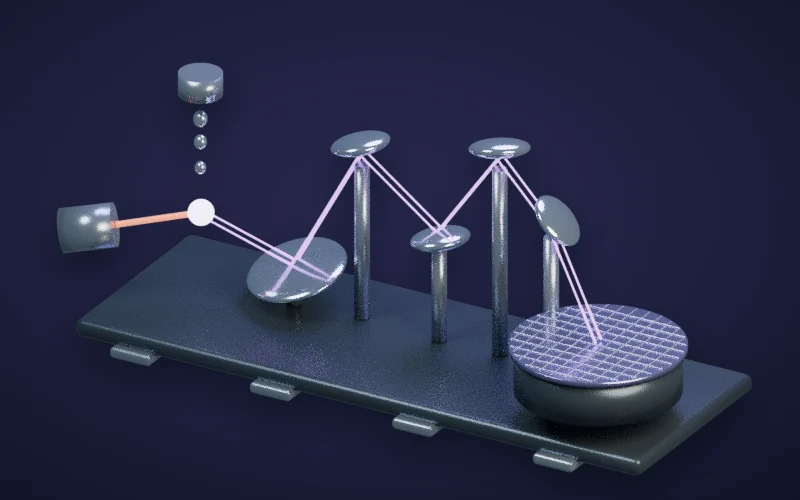
Pause a tin droplet in midair. Fire two laser pulses, then follow the light from a tiny plasma all the way to a silicon wafer.
How it works
Why put a mirror where you expect a lens?
- Make the light
- The first pulse reshapes a tin droplet. The second heats it into a plasma that emits extreme ultraviolet light, including light at the 13.5-nanometer wavelength the machine uses.
- Carry a pattern
- Air and ordinary glass absorb this light. Inside a vacuum, specially layered mirrors guide it to a reflective mask. Different regions on the mask return different amounts of light, forming a pattern.
- Expose one layer
- Projection mirrors produce a smaller image on light-sensitive resist covering the wafer. Subsequent processing turns that exposure into a physical pattern. A finished chip takes many patterned layers.
Sources and further reading
Explore another exhibitWhere does a can get its height?
→