 Curious MachinesAll exhibits
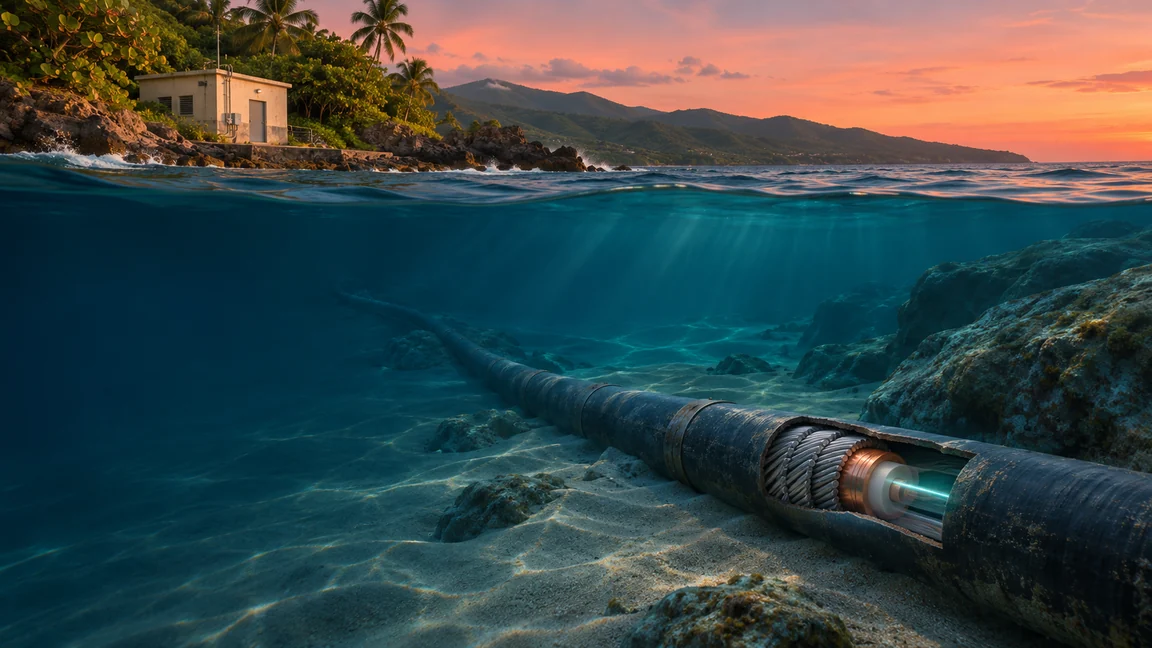
A voice beneath
the Atlantic.
What does it take to get one voice note from this shore to another?
It starts on land.
A landing station takes the bits in a voice note and encodes them onto light. Follow that light below the surface.
Outgoing voice note
“The water is warm. Wish you were here.”
Received voice note
Optical power along the cable
dB relative to launchOne cable.
Two jobs.
Light carries the message.
The transmitter varies light to encode data. Each stretch of glass loses some optical power. A repeater uses an optical amplifier to give the incoming light a boost.
Copper supplies the power.
Electric current from shore powers the underwater equipment. The surrounding insulation keeps the conductor separate from seawater. Heavy armor helps protect nearshore sections where the cable is more exposed.
Model assumptions and sources
This is a fictional three-span crossing. Each span loses 8 dB and each working repeater adds 8 dB. The receiver needs −12 dB relative to launch in this example. The first repeater can lose its gain independently. The second stays powered. Actual cable systems have many spans, additional losses, noise and redundancy.
The glow, colors and travel time make the signal visible. The voice note is a synthesized sample. The coast and equipment locations are illustrative.
International Cable Protection Committee · About submarine telecommunications cables