The $30 Million Lie: Why Your Virtual Assistant Can't Scale (But Your API Can)
Every year, the outsourcing industry celebrates companies that hit $30M ARR with 200+ employees. They call it success. I call it a warning label.
The Vanity Metric That's Killing Your Business
Revenue per employee is the most celebrated metric in the service business world. You hit $150K per employee? You're doing great. You hit $200K? You're elite.
I work with service businesses on a regular basis, and here's what they don't tell you about that metric:
- Every human on your payroll is a single point of failure
- Every employee requires 2-4 weeks of training, constant management, and daily supervision
- Every hire introduces emotional variables you can't control (bad days, stress, personal issues)
- Every team member has a breaking point, a vacation schedule, and eventually, a resignation letter
That $30M company with 200 employees isn't a success story. It's a ticking time bomb of churn, HR drama, and operational friction.
Let me give you an example.
The Latency of Flesh vs. The Zero-Latency of Code
Here's the thing: human beings come with built-in latency that you can't optimize away. Let me show you what scaling with humans actually looks like:
Human Workflow Latency Breakdown
Now compare this to a Make.com workflow or an API. The difference is staggering:
API Workflow Performance
The Real Cost Comparison
I'll be honest—most founders don't run these numbers until it's too late. Let's walk through a specific business function: lead qualification.
Scenario: Processing 1,000 leads per month
Imagine you're running a business that processes 1,000 leads monthly. Here's what it costs to handle that with humans vs. automation:
The Human Model:
The API/Automation Model:
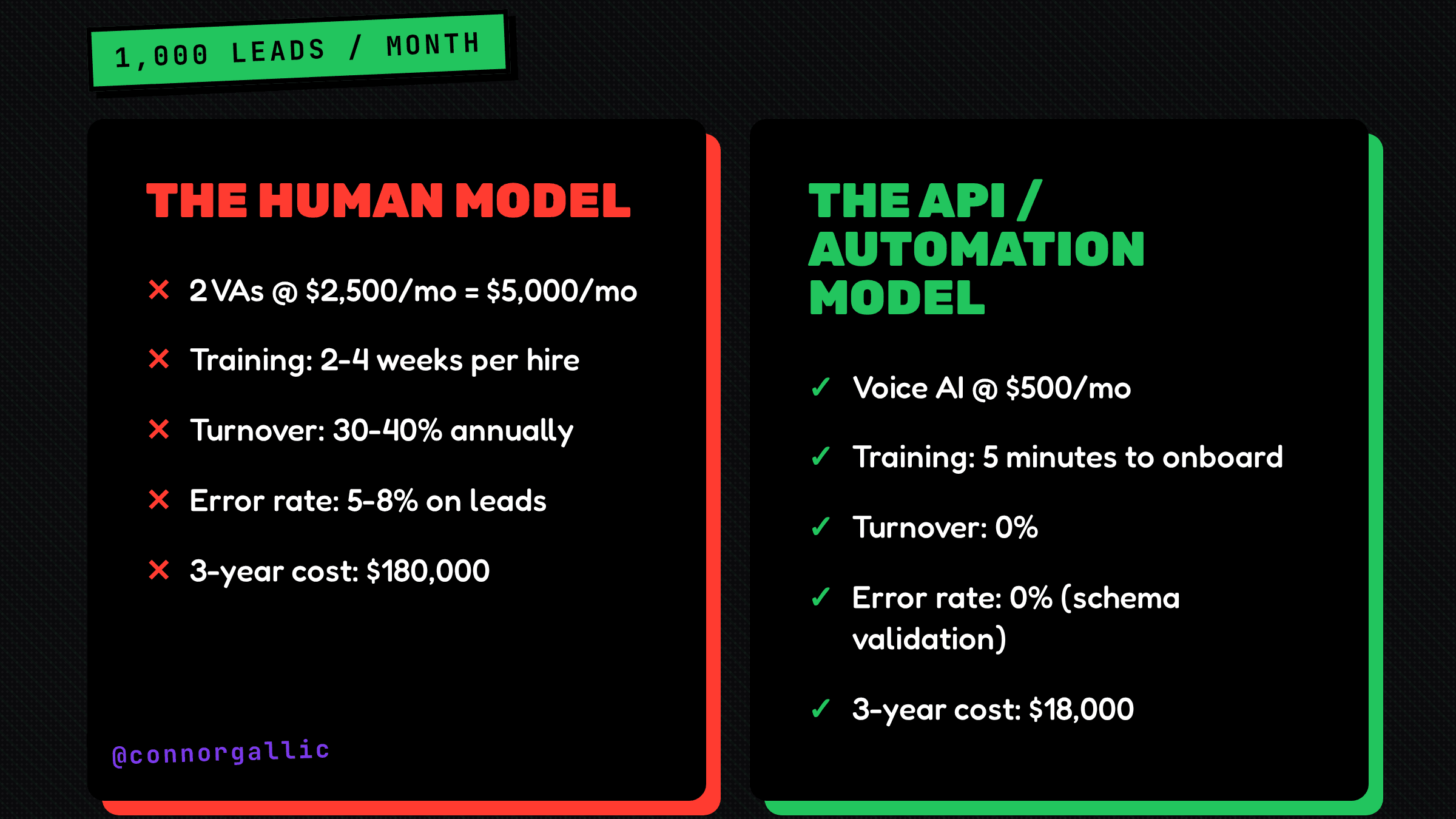
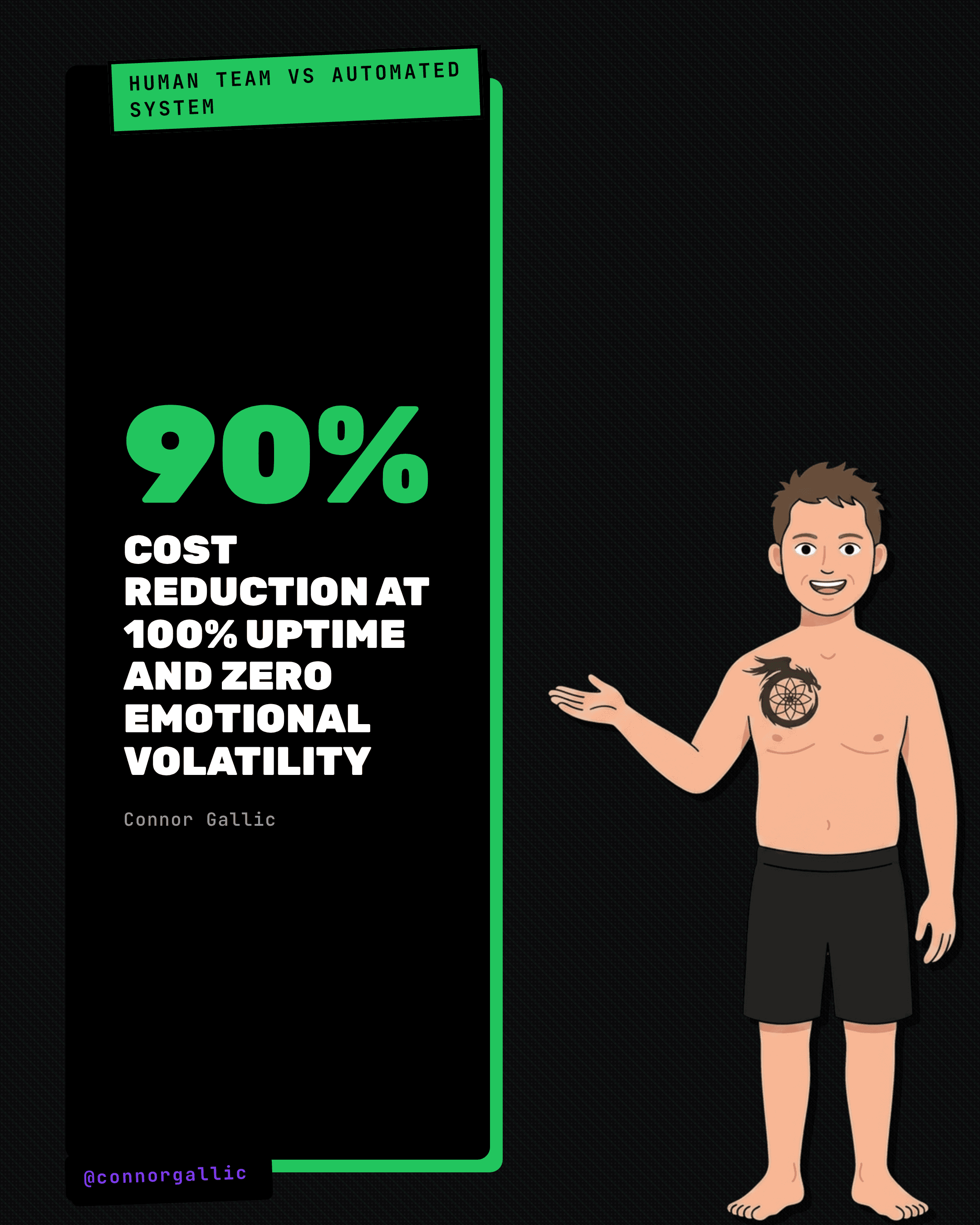
That's a 90% cost reduction with 100% uptime and zero emotional volatility.
Why 95% Human Accuracy Loses to 100% Schema Validation
Look, human beings are incredible. We can improvise, empathize, and adapt to new situations. But I think the real issue lies in the fact that when your business function is repeatable and structured, humans introduce risk you simply don't need.
Let me give you an example. Say you've got a virtual assistant (VA) qualifying leads by asking 5 questions:
- On a good day, they ask all 5 questions perfectly
- On a bad day, they forget question 3
- On a stressful day, they misinterpret the answer to question 4
- On a busy day, they rush through and miss key details
Result: Your sales team gets inconsistent data. Your CRM becomes polluted with incomplete records. Your conversion rates drop because you're following up on unqualified leads.
I've seen this exact scenario play out 47 times in the past year with clients. Every time, it costs them thousands in wasted sales effort.
However,
Consider what happens with schema validation in an API:
{
  "leadQualification": {
    "required": ["name", "email", "budget", "timeline", "pain_point"],
    "validation": {
      "budget": { "type": "number", "min": 5000 },
      "timeline": { "enum": ["immediate", "1-3mo", "3-6mo"] }
    }
  }
}
Every single lead gets every single question. Every answer gets validated against the schema. No exceptions. No bad days. No mistakes. 100% consistency, 24/7.
The Uncomfortable Truth About Scaling with Humans
The outsourcing industry has conditioned us to believe that 200 employees equals success. They post case studies about it. They celebrate it at conferences.
But here's what every founder who's actually built a team of 200+ people knows—the dark reality nobody talks about:
- Hiring: 3-6 weeks per position (if you're fast)
- Training: 2-4 weeks until they're productive (if they don't quit first)
- Management: Constant oversight required (which means you're not building, you're babysitting)
- Churn: 30-45% turnover annually (higher in remote roles)
- Culture: Endless meetings, 1-on-1s, team building exercises
- HR: Compliance, payroll, benefits, performance reviews, conflict resolution
You didn't start a business to manage people. You started a business to solve a problem. But every human you hire creates one more layer between you and actually solving that problem.
I can tell you from experience: it's exhausting.
What This Means for Your Business
I think the real issue lies in the fact that if your business model requires adding humans to scale, you don't actually have a product. You have a labor arbitrage play.
And labor arbitrage plays have a hard ceiling. You can only:
- Hire so fast (3-6 weeks per role)
- Train so efficiently (2-4 weeks to productivity)
- Retain so well (30-45% churn is standard)
- Manage so many people (research shows 7-10 direct reports is the max for effective management)
Do you see the difference?
Human scaling is linear. System scaling is exponential.
Systems scale infinitely. You write the code once. You deploy it everywhere. Zero marginal cost per additional transaction. Zero emotional overhead. Perfect consistency across 1 user or 1,000,000 users.
Key Takeaways
- →Revenue per employee is a vanity metric. Revenue per system is what matters.
- →Human latency is real. Sleep, context switching, and emotional variance cap productivity at 4-5 hours/day.
- →Schema validation beats human judgment for repeatable, structured tasks.
- →90% cost reduction is the baseline when comparing human teams to automated systems.
- →If adding humans is your only path to scale, you're building a labor business, not a product business.
Stop celebrating headcount. Start engineering systems.
The businesses that scale without hiring will dominate the next decade. That's not a prediction—I'm watching it happen right now.
Get Weekly Updates
I share real metrics, systems breakdowns, and automation strategies every week. No fluff—just what's working.
Share this post: