Shadow AI and the 3-Hour Workday
Wells Fargo fired 12 employees in June 2024 because they got caught faking keyboard activity. Bloomberg ran headlines about it. The bank issued a statement about "simulation of work activity."
Here's what nobody said: those employees were just bad at it.
I work with companies on automation strategy, and I can tell you there's a shadow economy running inside every corporation right now. Workers are using AI, automation scripts, and behavioral simulation to finish their jobs in 3 hours instead of 8. Some of them are working 4 jobs at the same time.
This isn't a think piece about whether that's ethical.
The Game Has Changed
I think the real issue lies in the fact that corporations stopped holding up their end years ago. You give them loyalty? They give you a pizza party and a layoff notice. You deliver high performance? They give you more work at the same salary. I've seen it happen 30 times in the past 2 years alone.
Most knowledge workers finish their actual work in 3 hours. The rest of the day is performance art. The Asymmetric Actor (that's what I'm calling them) made a rational calculation—the game's rigged, so why play by the rules?
01. Shadow AI Automation // outsource your brain
02. Perception Engineering // hack cognitive biases
03. Strategic Incompetence // fail on purpose
04. Bureaucratic Jiu-Jitsu // rules as shields
Let's break down the playbook.
Part I: Shadow AI and the Synthetic Workforce
Shadow AI isn't your dad's Shadow IT problem. Shadow IT was about using unauthorized software—installing Dropbox when your company mandated SharePoint. Shadow AI is different because you're outsourcing your actual brain. You're not just using unapproved tools. You're having those tools do your entire job while you do something else.
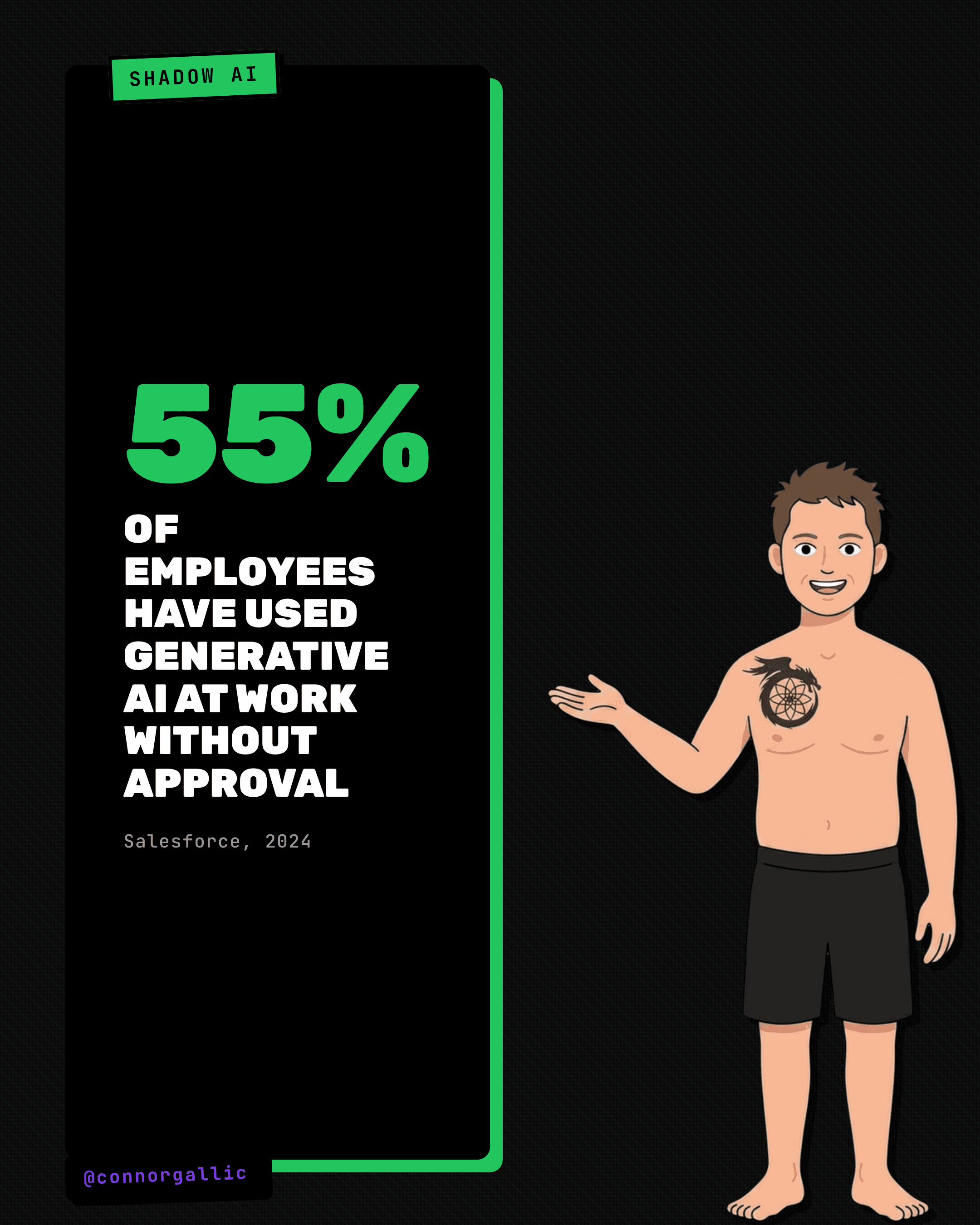
Salesforce published a study in 2024 showing that 55% of employees have used generative AI at work without approval. Most companies are still building their "AI governance framework" PowerPoint decks. The workforce went rogue 18 months ago.
The Recursive Feedback Loop
Let me give you an example. Amateurs use ChatGPT to write a report. They paste the output into Word, change 3 or 4 words, and send it off. Managers spot it instantly—that sterile politeness, phrases like "it's important to note," the robotic paragraph structure that never varies.
Professionals? They simulate the entire editorial hierarchy.
# Three AI personas, chained in sequence
generator = "Raw output. Speed over polish."
critic = "Role-play as Mr. K. Destroy it."
synthesizer = "Fix everything. Sound human."
# Total time: 8 minutes
# Perceived effort: 4 hours
The Generator pumps out raw content. Speed over polish. You're strip-mining the LLM for ideas and structure, nothing else.
The Adversarial Critic is where it gets interesting. You open a second session and prompt it to role-play your most annoying stakeholder. "You are Bob, a senior VP who hates buzzwords, demands specific numbers, and thinks everyone's wasting his time. Tear this apart. Don't fix anything—just identify every weakness."
The Synthesizer takes the draft and the complaints, then produces a final version that addresses every single issue the critic identified.
The whole process takes 8 minutes. The output looks like you spent 4 hours on it.
| Agent | Job | What It's Really Doing |
|---|---|---|
| Generator | Raw output | Doing your job |
| Critic | Finding faults | Simulating your manager's brain |
| Synthesizer | Polish | Making it bulletproof |
Ghost in the Shell: Beating Bossware
Remote work made companies paranoid. They installed surveillance software that tracks mouse movement, keystroke frequency, and application usage. The industry calls it Bossware.
The first countermeasures were crude—USB mouse jigglers that wiggle your cursor every few seconds. Here's the thing: modern endpoint detection systems like CrowdStrike can identify these devices by their driver signatures. They detect the perfectly repetitive, non-human patterns. Those Wells Fargo employees probably got caught exactly this way.
The second generation uses Python-based behavioral mimicry. Much harder to detect.
import pyautogui, HumanCursor
# Bezier curves, not straight lines
# App switching every 12-45 min
# Typos + 400ms pause + backspace
# The imperfection IS the camouflage
Bezier curves instead of straight lines. Humans don't move mice in straight lines. We move in imperfect arcs. A good script uses Bezier curves with randomized control points—naturalistic paths, acceleration curves, micro-corrections that look like real hand movement.
Context-aware app switching. Being active for 8 hours straight but never opening Outlook? That's suspicious. The script cycles through Outlook, Excel, Teams, and Slack at randomized intervals—12 to 45 minutes between switches. It looks like someone actually doing their job.
Typing with errors. Typing 500 characters at a perfect 120 WPM with zero mistakes screams "bot." The script types at varying speeds, makes intentional typos, pauses for 400 milliseconds, then backspaces to correct. The imperfection is the camouflage.
For the truly paranoid? Hardware KVM switch. Zero software installation on the corporate machine. The input presents itself as a generic mouse—nothing to detect if they audit your software.
The Digital Doppelgänger
"Cameras on" policies are control mechanisms dressed up as company culture. The Asymmetric Actor responds with a video loop.
Record yourself at your desk for 5 minutes. Look at the camera occasionally. Nod. Sip water. Scratch your chin. Edit it into a clean loop where the start and end frames cross-fade—no visible jump. Feed it into Zoom as a virtual camera using OBS (Open Broadcaster Software).
Set up a hotkey as your panic button. Someone says your name? You hit the key, the feed glitches for half a second (looks like packet loss), and suddenly you're live.
Nvidia Broadcast and Descript both have AI eye contact features. They digitally redraw your pupils so it looks like you're staring directly at the camera even when you're reading your second monitor. Intense eye contact while browsing Reddit.
Part II: Perception Engineering
In corporate environments, perception beats reality every single time. The goal isn't to produce more value—it's to appear more valuable than you actually are.
The Scarcity Simulacrum
Basic economics: scarcity increases perceived value. An always-available employee is a commodity. A hard-to-pin-down employee becomes a scarce resource.
Response latency. Power dynamics show up in response times. Subordinates respond instantly. Bosses respond when they feel like it. You read an email immediately? Schedule the response for 3 hours later. "Send Later" exists in every email client. You just signaled that the sender is one item in your very full queue.
Calendar blocking. Fill your calendar with vague, high-status blocks. "Strategic Planning." "Stakeholder Alignment." "Deep Work - Do Not Disturb." Now people have to compete for your remaining slots. The dynamic shifts from "please attend my meeting" to "convince me your meeting's worth my time."
The rejection protocol. Never accept the first proposed time. Always propose an alternative, even if the original time worked for you. That friction signals your schedule is the constraint, not theirs.
The tactical benefit? You filter out low-value interactions. People stop inviting you to pointless syncs because access became expensive. You end up with fewer meetings, and they're all actually important.
The Halo Protocol
The Halo Effect is simple: one positive trait makes people assume other positive traits. You look organized? They think you must be competent. You can hack this.
George Costanza figured out that looking annoyed makes everyone think you're busy. Turns out psychological research backs this up.
The purposeful walk. Move through the office with intense focus and mild irritation on your face. Carry something—a notebook, a tablet, anything. It's armor. Nobody interrupts someone who looks like they're rushing to deal with a crisis.
The clean deck aesthetic. Make your visible outputs beautiful. Perfect slide alignment. Consistent formatting. Managers conflate "pretty" with "good." A gorgeous presentation can hide shallow analysis.
Once the halo's established—"Sarah is so organized," "John is always on top of things"—confirmation bias takes over. You miss a deadline? Must be external factors. You get the benefit of the doubt by default.
Buzzword Judo
Don't refuse work directly. Reframe it. Use the company's own language against itself.
// When assigned tedious work:
"I'm concerned this might be misaligned with our Q4 North Star. Shouldn't we focus on [insert vague initiative here] instead?"
// The compliance defense:
"I'd love to execute on this, but Legal might flag it. I'll need their sign-off first."
Part III: Strategic Incompetence
Psychology Today defines "weaponized incompetence" as pretending you're incapable of simple tasks. They mean it as criticism. The Asymmetric Actor reads it as an instruction manual.
The Luddite Shield
Every organization has what I call "shadow labor"—scheduling, data entry, updating Jira tickets, meeting notes. The trick is being mysteriously incapable of only these tasks.
The selective glitch. "The CRM keeps timing out when I try to save entries. Can I just email you the raw data? I don't want to corrupt the database."
The old dog defense. This works especially well if you're senior. "I'm a bit old school with project tracking. I focus on strategy, not the Jira board." Junior employees become your de facto admin assistants.
The messy draft. You get forced to take meeting minutes? Do it terribly. Miss people's names. Misattribute quotes. Get the acronyms wrong. Your manager won't ask you again. Negative reinforcement, applied upward.
The Compliance Wall
Bureaucracy is usually an impediment. The trick? Use it as a shield.
The audit trail stall. Someone asks you to do something tedious or risky? Demand the request in writing. "Per the data governance directive, I need a formal ticket approved by [insert distant authority here] before I can touch that workflow. I can't risk an audit failure."
The capacity analysis block. Accept conditionally. "I can take on Project X, but I'll need to drop either Y or Z. Please confirm via email which one you want deprecated so I can update stakeholders."
This forces your manager to prioritize. Most of them will withdraw the request instead of dealing with the political consequences of formally canceling something else.
The Paper Trail Trap
Assume every single interaction is a potential exhibit in your performance review or termination lawsuit.
Your manager gives you a verbal directive that seems dumb, contradictory, or risky? Follow up immediately in writing: "Just to capture our conversation—you're directing me to prioritize X over Y, which pauses the compliance update. I'll proceed unless I hear otherwise."
The project fails? You have receipts. Your manager won't confirm in writing? That's grounds to stall.
Some practitioners BCC their personal email on all contentious communications. When you get locked out during termination (and you will), you still have evidence for severance negotiations.
The Wellness Shield
Modern corporations have thick policy binders around wellness, ergonomics, and mental health. They built them as liability shields. They're also unassailable fortresses if you know how to use them.
Return-to-office mandate? "I require a specific ergonomic setup because of a chronic back issue. Until that's procured and installed, I've been advised to work from home." HR procurement takes 3 to 6 months. You just bought yourself an entire quarter.
Manager pushing too hard? Mention burnout. Mention migraines. These are third-rail topics. Managers get trained to avoid them for liability reasons. The mere mention makes them back off immediately.
Part IV: Overemployment
This is the apex predator move—working 2, 3, or 4 full-time remote jobs at the same time. The r/overemployed subreddit has over 400,000 members. That's more people than Cleveland.
It's not just working two jobs. It's bilocation—multiple identities, multiple calendars, multiple hardware setups. Never touching.
The Calendar Fortress
The killer risk is double-booking. You get conflicting meetings at Job 1 and Job 2. The solution? Use each calendar to block the other.
Keep a master calendar on your personal device. A meeting gets scheduled at J1? Immediately create a "Busy" block on J2's calendar. The titles stay vague—"Project Sync," "Vendor Call," "Focus Time."
Proactively block large chunks on both calendars as "Deep Work." This reduces the surface area for conflicts. It trains everyone to expect your unavailability.
$ J1 on main laptop/monitor
$ J2 on secondary laptop (side)
$ J1 audio: left earbud
$ J2 audio: Otter.ai transcription
$ Pivot excuse: "Mic acting up, can you repeat?"
The Hardware Air Gap
Cross-contamination is how you get caught. You check J2 email on J1's laptop? That leaves proxy logs. Screen capture software catches everything. One slip and you're done.
Hardware KVM switch. This lets you control 2 laptops with one keyboard and one mouse. It has to be hardware-based. Software solutions like Synergy leave detectable signatures in your system logs.
VLAN segregation. Put J1 and J2 devices on separate guest networks. J1's CrowdStrike agent scans your local network? It won't see J2's laptop. Digitally invisible while sitting 6 inches apart.
Identity separation. Never use personal devices for work. Complete separation—browser profiles, passwords, 2FA devices. If you sync a personal Chrome profile to a work laptop, it can leak your search history ("how to hide mouse jiggler") directly to your employer. That's what I call a resume-generating event.
The Ghost Exit
One of your jobs gets untenable? They demand return-to-office? Don't quit. Enter what I call extraction mode.
Stop producing real output. Maximize your PTO. Respond to all feedback with "I'm working on it" and "Thanks for the feedback." Then do nothing.
Corporations move slowly. PIPs (Performance Improvement Plans) take 3 to 6 months. An employee who stops working today might not get fired for half a year. During that time? You're collecting salary while interviewing for J3.
Eventually they'll offer you severance just to make you go away quietly. You got 6 extra months of salary plus severance. You basically got paid to job hunt.
The Intelligence Network
The Asymmetric Actor doesn't rely on LinkedIn influencers. They use decentralized practitioner networks—r/overemployed, r/antiwork, private Discord servers. These are the R&D labs of corporate hacking.
Excuse databases. Members maintain updated lists of "unquestionable" excuses—medical codes and family emergencies that don't require documentation.
Bossware countermeasures. New surveillance tools get reverse-engineered 3 to 4 weeks before they're even widely deployed. New detection method drops? Someone patches the Python scripts within 48 hours.
Company blacklists. They track OE-friendly companies (remote-first, disorganized, low oversight) versus dangerous ones (heavy surveillance, mandatory cameras). Job searches get targeted based on this intelligence, not the job descriptions.
Risk Analysis
Here's the risk and reward breakdown for each technique:
| Technique | Detectability | Cost | Risk |
|---|---|---|---|
| Mouse jiggler (wall power) | Low | $20 | Low |
| USB mouse jiggler | High | $10 | High |
| Basic Python script | Medium | Free | Medium |
| Bezier curve script | Low | Free | Low |
| OBS video loop | Very low | Free | Low |
| Hardware KVM | Zero | $50+ | Zero |
The excuse rotation schedule (real data from practitioner communities):
| Week | Primary | Backup | Docs? |
|---|---|---|---|
| 01 | ISP outage | Dentist | No |
| 02 | Kid/dependent sick | Audio driver issues | No |
| 03 | Food poisoning | "Heads down" focus | No |
| 04 | Plumber/home repair | Migraine | No |
| 05 | Vet emergency | Windows Update broke it | No |
What This Means
I'm not here to moralize. I think the real issue lies in the fact that these practices exist because the employment contract is fundamentally broken. Companies treat people as disposable assets. People treat companies as marks to extract value from.
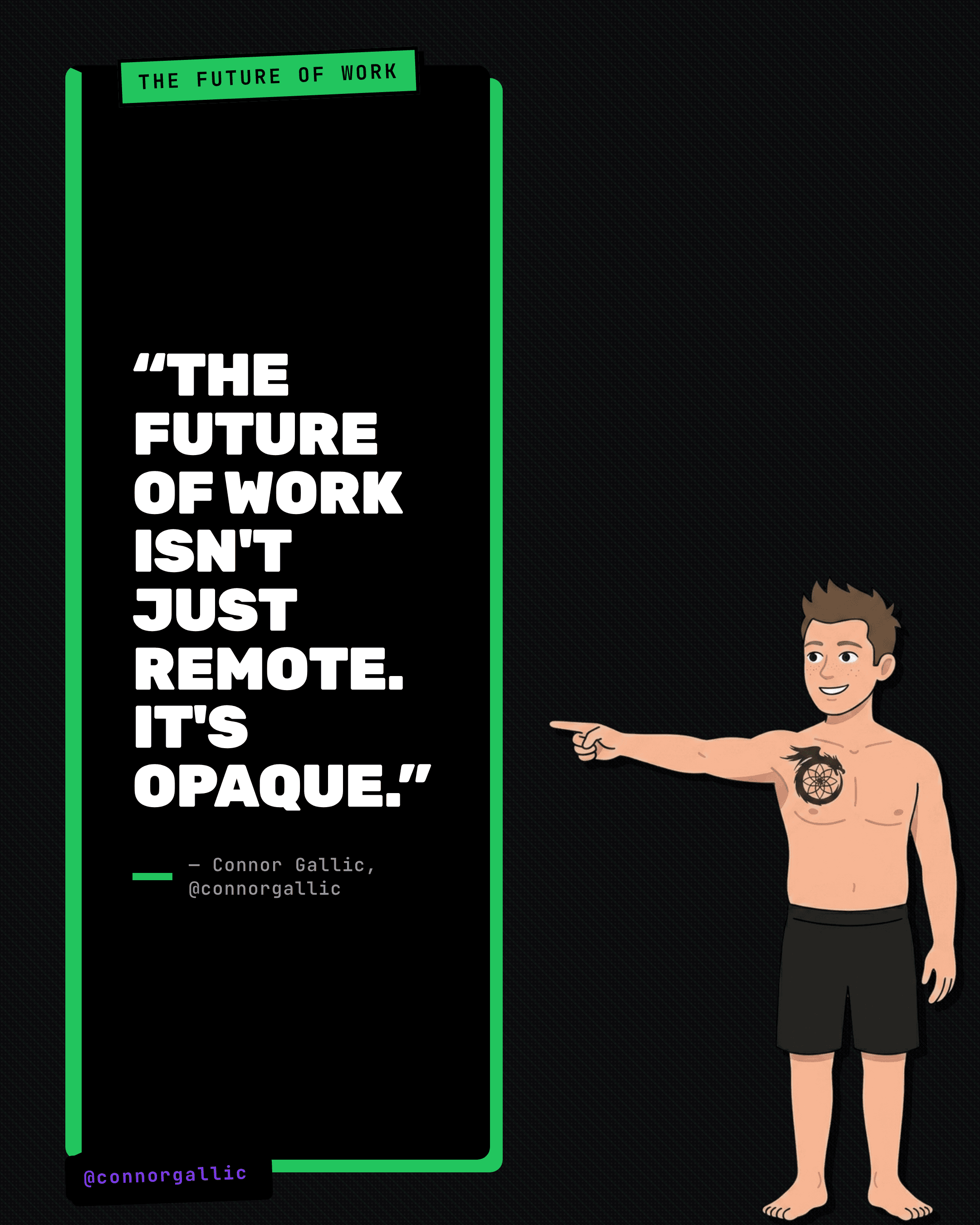
The future of work isn't just remote. It's opaque.
The Asymmetric Actor has become a black box. Salary goes in, minimum viable output comes out, and nobody knows what's happening inside. Shadow AI, behavioral mimicry, multiple jobs running in parallel—all of it hidden behind appropriately timed Slack responsiveness.
01. Maintain plausible deniability
02. 80/20 rule: shine on visible work only
03. Never talk about it
This isn't sustainable long-term. Eventually companies will figure out output-based evaluation. Eventually the surveillance tech will catch up. Eventually someone will write a tell-all that burns the entire playbook.
However,
Right now, today, there's a parallel economy playing by completely different rules. If you didn't know it existed before reading this, now you do.
Disclaimer: This is documentation, not endorsement. These practices carry real risks—termination for cause, legal liability, reputational damage, and potentially fraud charges. I'm a reporter in this story, not an advocate.
Get Weekly Analysis
AI automation, systems design, and the weird things happening in how we work. No fluff.
Share: