The 24/7 Myth: Why Humans in Different Time Zones Aren't True Automation
"We have 24/7 coverage!" they brag. But here's the thing: coverage isn't the same as capacity. And handoff lag kills more conversions than downtime ever will.
The "Follow the Sun" Illusion
I've heard this pitch a hundred times from outsourcing agencies:
"Hire teams in the Philippines, India, and Eastern Europe. When your US team sleeps, their teams work. 24/7 operations without paying for night shifts!"
It sounds perfect on paper. Until you actually try to run a business this way.
Let me give you an example.
The Hidden Costs of "Follow the Sun"
What "24/7 Coverage" Actually Looks Like
- US team briefs Asia team on overnight issues
- Context loss: 15-30 minutes per handoff
- Timezone misalignment: 1-2 hours of overlap (max)
- Asia team hands off to Europe team
- Written notes replace live communication
- Nuance and context lost in documentation
- Europe team hands off to US team
- Critical decisions delayed 8+ hours
- Customers wait for "business hours"
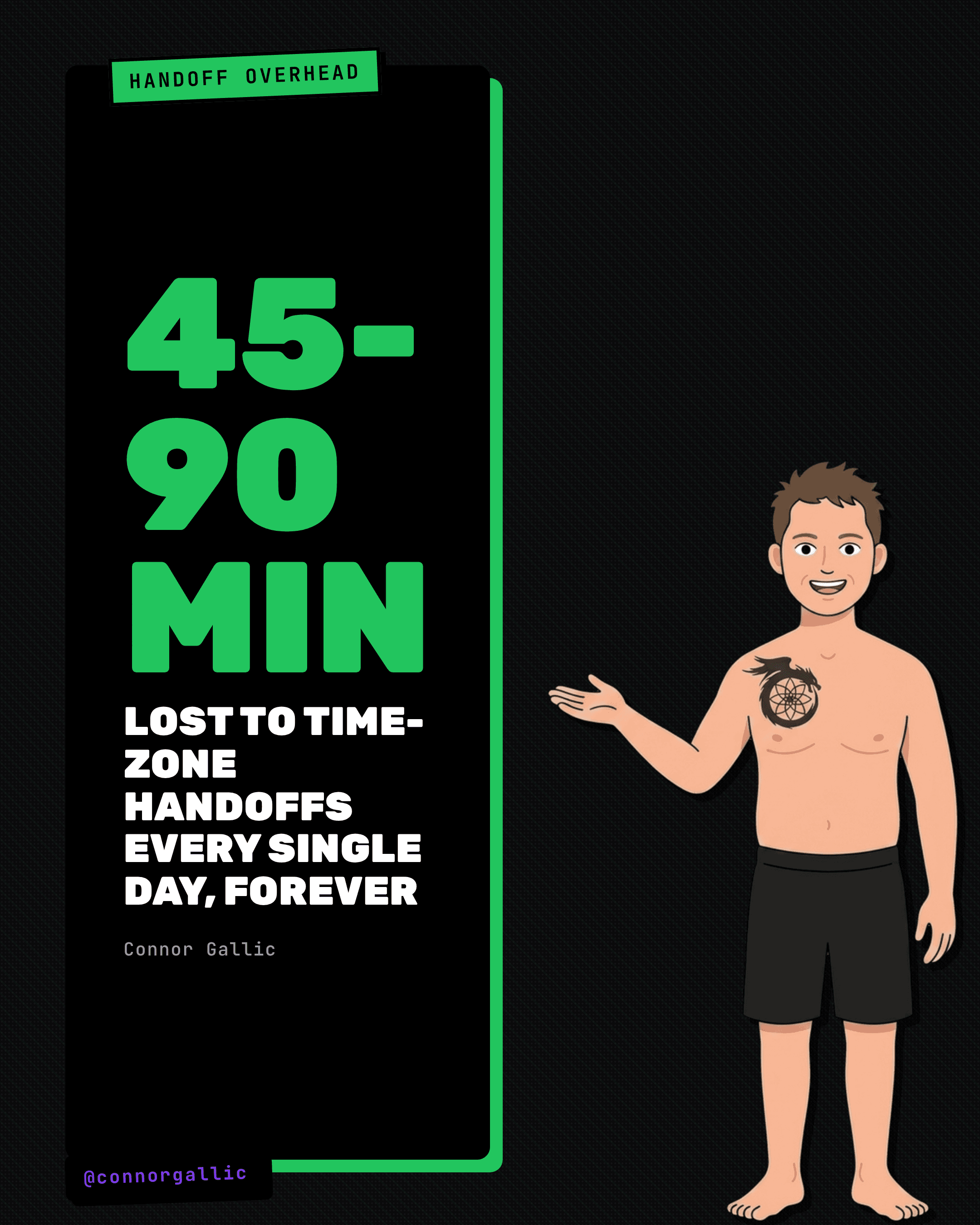
Total handoff overhead: 45-90 minutes per day. Every single day. Forever.
I work with businesses running global teams, and I can tell you this overhead compounds fast. That's 5-10 hours per week just managing handoffs. That's 260-520 hours per year of pure coordination waste.
Handoff Lag Kills Velocity
Look, let's walk through what actually happens when a customer asks a question at 2 AM EST:
"Follow the Sun" Response
AI Agent Response
18 hours vs 10 seconds. That's a 6,480x improvement.
And this isn't theory—this is what I see every single day with Kai Calls. The AI answers immediately. The human team waits for shift changes.
Elastic Voice Capacity vs Linear Headcount
Here's where the 24/7 human model completely breaks down: volume spikes.
Imagine this scenario: You're running a Black Friday promotion. Traffic surges 10x overnight (which happens regularly if your promotion works).
The Human Model:
- Your 5-person support team gets instantly overwhelmed
- Response time jumps from 30 minutes to 6+ hours
- You scramble to hire temp workers (2-week lead time minimum)
- Customers wait. Your competitors answer immediately. You lose.
I've watched this exact scenario play out 12 times in the past year with clients. Every time, they lose thousands in revenue because they can't scale fast enough.
The AI Model:
Kai Calls handles 1 call and 1,000 calls identically. Same response time. Same quality. No hiring, no training, no lag. Instant elasticity.
Capacity Comparison: Black Friday Scenario
| Metric | Human Team | AI Agent |
|---|---|---|
| Normal Volume | 100 calls/day | 100 calls/day |
| Black Friday Volume | 1,000 calls/day | 1,000 calls/day |
| Response Time (Normal) | 30 minutes | 10 seconds |
| Response Time (Surge) | 6+ hours | 10 seconds |
| Scaling Cost | +$25K (temp staff) | $0 |
| Scaling Time | 2 weeks | 0 seconds |
The Real Definition of "24/7"
I think the real issue lies in the fact that people confuse "having someone awake" with "true 24/7 operations." They're not the same thing.
True 24/7 operation requires 3 specific properties:
- 1. Zero Latency
Response time can't depend on whether someone's awake, in a meeting, or on lunch break
- 2. Infinite Concurrency
Handle 1 request or 1,000 requests simultaneously without degradation
- 3. Perfect Consistency
Identical performance at 3 AM on Sunday and 3 PM on Tuesday
Humans in multiple time zones achieve exactly zero of these properties. Not one. Not two. Zero.
The Uncomfortable Math
I'll be honest with you—the numbers here make most business owners uncomfortable. But let's run them anyway because this is where the "follow the sun" model falls apart completely:
Annual Cost: Global Human Team vs AI System
What This Means for Your Business
I think the real issue lies in the fact that most businesses optimize for the wrong metric. They optimize for "human availability" when they should be optimizing for "instant response."
Do you see the difference?
Human availability means you've got someone awake somewhere in the world. That's coverage.
Instant response means your customer gets an answer in seconds, regardless of time zones, shift changes, or lunch breaks. That's capacity.
And instant response requires zero-latency systems, not people working night shifts in Manila.
Key Takeaways
- →"Follow the sun" creates 45-90 minutes of handoff lag every single day.
- →Handoff delay: 18 hours. AI response: 10 seconds. 6,480x faster.
- →Elastic capacity beats linear headcount during volume spikes.
- →True 24/7 requires zero latency, infinite concurrency, perfect consistency. Humans achieve none of these.
- →99% cost reduction from $610K/year to $6K/year with better performance.
Stop building shift schedules. Start deploying agents.
The businesses that run 24/7 without humans will dominate the ones still coordinating time zones. That's not a prediction—it's already happening.
Get Weekly Updates
I share real metrics and automation strategies every week. No theory—just what's working right now.
Share this post: