Programmatic Dominance: Why Your Writer Team Can't Beat My Vector Database
I work with marketing directors who hire 50 writers to scale content. They spend $125,000 per month. I write 1 script. We both generate 10,000 pages. Only one of us is paying salaries.
The Content Production Bottleneck
Here's the thing—most companies approach content like this:
- Hire writers
- Create content briefs
- Wait for drafts
- Review and edit
- Publish
- Repeat forever
I think the real issue lies in the fact that this model has 3 fatal flaws:
- It's slow—each piece takes days to weeks
- It's expensive—$0.10 to $0.50 per word adds up fast
- It doesn't scale—want 10x content? Hire 10x writers.
Meanwhile, Awesome Backyard generates 10,000+ SEO-optimized pages from a single template and a vector database. Let me show you how.
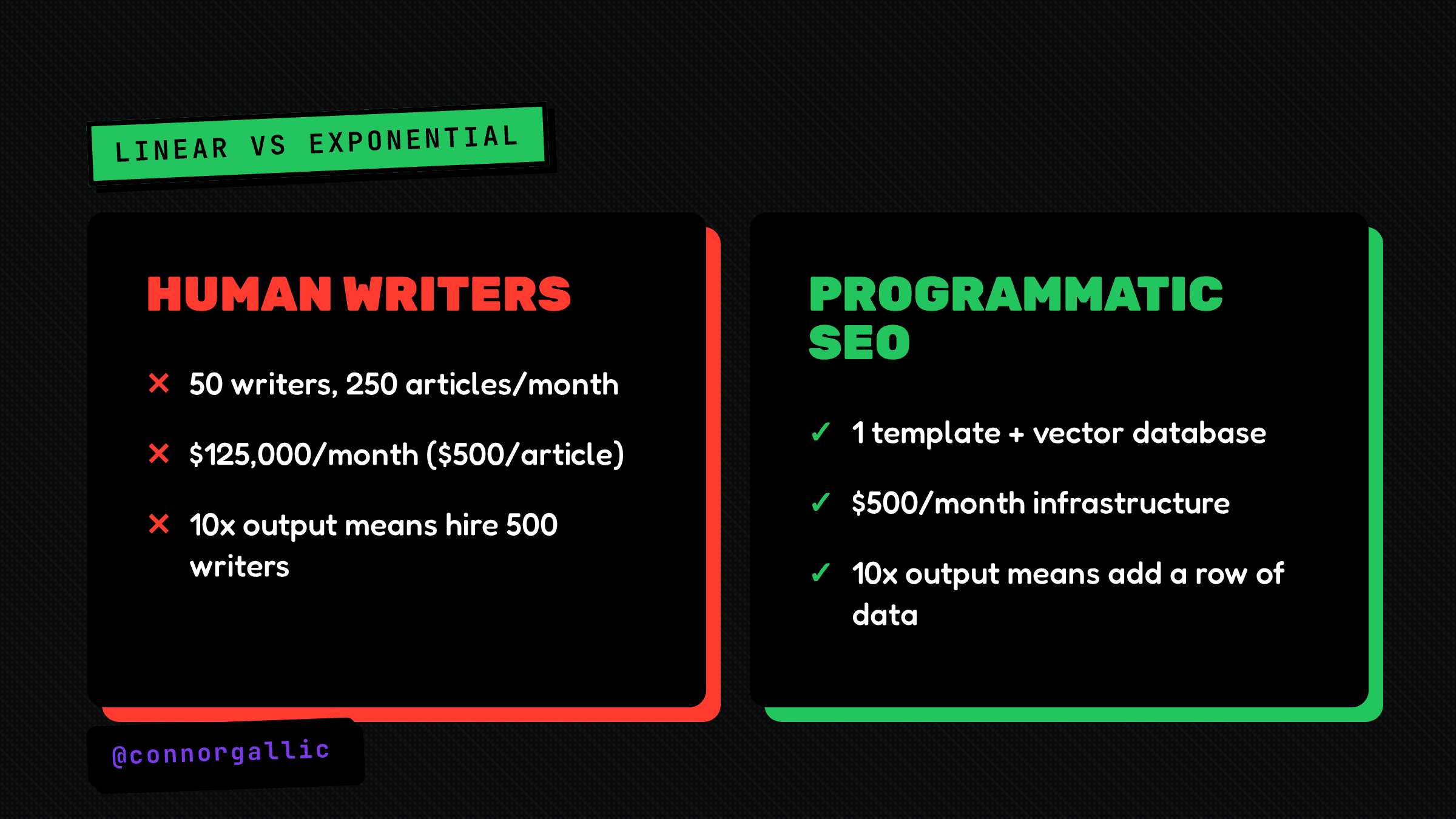
Linear vs Exponential Content Production
The Linear Model (Human Writers)
The Exponential Model (Programmatic SEO)
How Programmatic SEO Actually Works
Let me give you an example. I'll show you the exact architecture behind Awesome Backyard because this is how I generated 10,000+ pages in January 2025.
Step 1: Build the Data Layer
Store structured data in Supabase (PostgreSQL + pgvector). Here's what the schema looks like:
-- Products table
CREATE TABLE equipment (
  id UUID PRIMARY KEY,
  name TEXT,                 -- "Bounce House"
  category TEXT,             -- "Inflatables"
  avg_rental_price NUMERIC,  -- 299.99
  description_embedding VECTOR(1536)
);

-- Cities table with geolocation
CREATE TABLE cities (
  id UUID PRIMARY KEY,
  name TEXT,                 -- "Austin"
  state TEXT,                -- "Texas"
  latitude NUMERIC,          -- 30.2672
  longitude NUMERIC,         -- -97.7431
  population INTEGER
);
Step 2: Write the Template (Once)
Create a single dynamic page template:
// Dynamic route: /[city]/[equipment]
export async function generateStaticParams() {
  const cities = await db.cities.findMany();
  const equipment = await db.equipment.findMany();

  // Generate all combinations
  return cities.flatMap(city =>
    equipment.map(item => ({
      city: city.slug,
      equipment: item.slug
    }))
  );
}

// Generate 10,000+ pages from 100 cities × 100 equipment items
Step 3: Internal Linking with Vector Search
Here's the thing—the secret sauce is automatic contextual linking using the Haversine formula and semantic similarity. I'll be honest, this is where most people give up because the math looks scary.
// Find 5 nearest cities geographically
SELECT city_name,
  ( 6371 * acos(
      cos(radians($latitude)) *
      cos(radians(city_latitude)) *
      cos(radians(city_longitude) - radians($longitude)) +
      sin(radians($latitude)) *
      sin(radians(city_latitude))
    )
  ) AS distance_km
FROM cities
ORDER BY distance_km
LIMIT 5;

// Find 5 most similar equipment items (vector similarity)
SELECT equipment_name,
  1 - (embedding <=> $current_embedding) AS similarity
FROM equipment
ORDER BY similarity DESC
LIMIT 5;
Result: Every page automatically links to 5 nearby cities and 5 related products. Zero manual work. Perfect SEO structure.
RAG: The Content Quality Multiplier
Look, I know what you're thinking—doesn't programmatic content feel generic and robotic?
Not with Retrieval-Augmented Generation (RAG). Let me break this down.
How RAG Works:
- Embed your knowledge base (product specs, reviews, FAQs) into vectors
- Query the vector database for relevant context
- Generate unique content using AI + retrieved context
Example: Generating Unique Content for "Bounce House Rental Austin"
"bounce house austin texas backyard parties"- Average Austin rental price: $299
- Popular for birthday parties (78% of rentals)
- Peak season: March-October (Texas heat)
- Average yard size in Austin: 7,200 sq ft
- Local regulations: Must have adult supervision
"Bounce house rentals in Austin average $299 for a full day, making them a cost-effective option for birthday parties—which account for 78% of bookings in the area. With Austin's warm climate extending the rental season from March through October, and the average backyard size of 7,200 sq ft providing ample space, bounce houses remain one of the most popular party rental options in Central Texas. Note: Texas regulations require adult supervision during use."
That content is unique, contextual, and SEO-optimized. And it was generated in 0.8 seconds.
The Real Cost Comparison
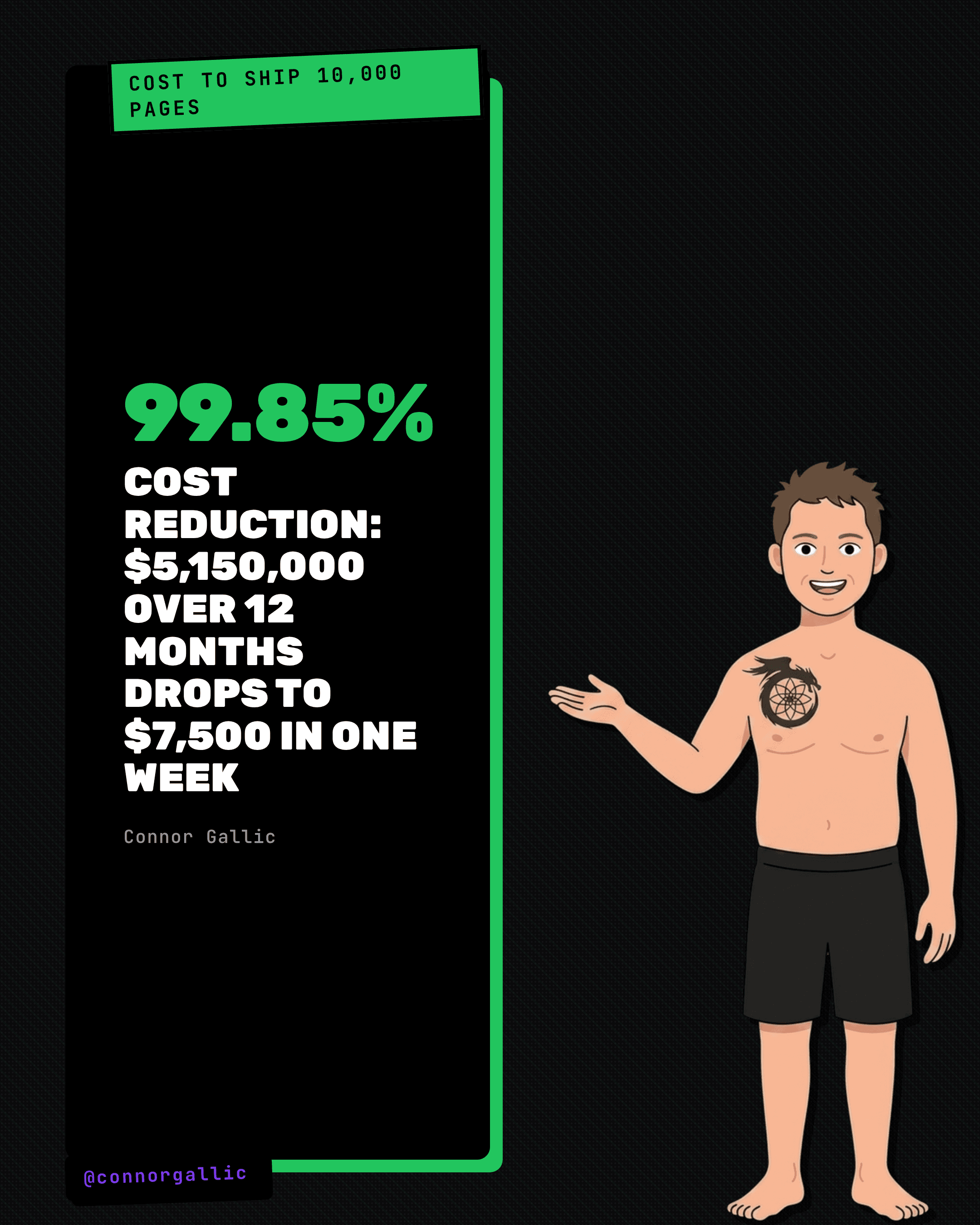
I'll be honest—the numbers shocked me the first time I ran them. Let's calculate what it costs to produce 10,000 city-specific landing pages:
Human Writers Model:
Programmatic SEO Model:
Why Writers Can't Compete
Look, it's not about writing quality. I think the real issue lies in the fact that it's about architectural leverage.
Writers scale linearly—2x content means 2x writers. Templates scale exponentially—2x content means add more data rows.
Let me give you an example. A team of 50 writers can produce 250 articles per month. A programmatic SEO system can produce 10,000 pages per hour.
That's a 40,000x productivity multiplier.
Real-World Example: Awesome Backyard
Let me show you the actual results:
Awesome Backyard Performance Metrics
The Future of Content is Code
If you're still hiring content teams to manually write SEO pages, you're competing with one hand tied behind your back.
Your competitors are writing templates. You're writing articles.
They ship 10,000 pages while you're still in the content planning meeting.
When Programmatic SEO Makes Sense
Not every content strategy should be programmatic. However,
I think the real issue lies in the fact that if your content has these 4 properties, you're leaving money on the table:
- Geographic variation—"Service in [city]"
- Parametric variation—"[product] vs [product]"
- Combinatorial keywords—"[category] for [use case]"
- Data-driven pages—"[city] statistics for [metric]"
Programmatic SEO will 100x your content output at 1/100th the cost if any of these apply.
Key Takeaways
- →Hiring 50 writers is linear. Writing 1 template is exponential.
- →Vector Search + RAG creates unique, contextual content at machine speed.
- →99.85% cost reduction: $5M → $7.5K for 10,000 pages.
- →40,000x productivity multiplier vs human writers.
- →The future of content is code, not copywriters.
Stop hiring content teams. Start writing templates.
Get Weekly Updates
Connor shares programmatic SEO strategies and real metrics every week.
Share this post: